
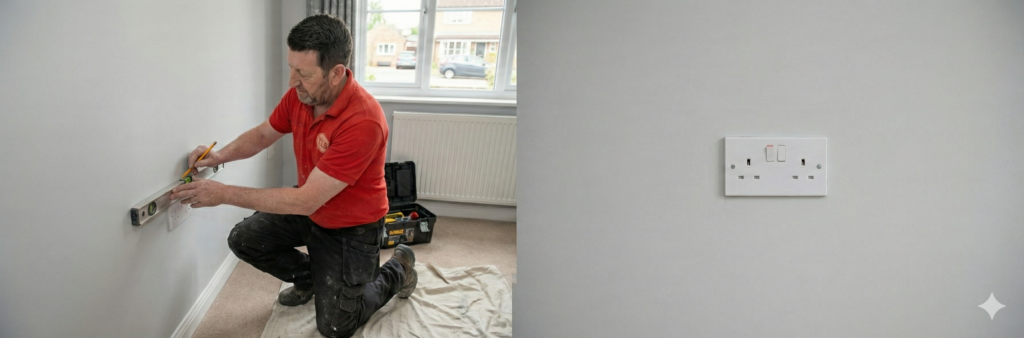
Run out of sockets? We add extra double sockets, USB points and spurs exactly where you need them — fished into walls neatly and tested on completion.
Why extra sockets matter (and trailing cables don't)
A home with too few sockets forces people to rely on extension leads and multi-way adapters. That's not just annoying — it's a fire risk. An overloaded extension reel running hot can ignite insulation; trailing cables get trip hazards; plugs yanked in and out of adapters wear out. Modern homes have devices everywhere — phone charging, laptop, smart speakers, e-readers, electric toothbrushes — and the wiring is usually 20+ years old. Adding sockets in the right places makes a space livable and safe.
Where to add sockets
Living room: One double socket per wall (three walls = 3 doubles), plus one or two USB sockets for phone/tablet charging. TV wall ideally has 2–3 doubles behind/beside the mounted screen. Kitchen: Every appliance wants power — fridge, dishwasher, microwave, kettle, toaster, phone charger. Plan for 2–3 double sockets per metre of worktop. Bedrooms: At least one double beside each bed (reading lights, phone charging, bedside fan in summer), plus 1–2 spares. Home office: Printer, desk lamp, monitor, laptop, phone, speaker — easily 3–4 sockets per desk. Bathroom: Shaver sockets, electric toothbrush, hair dryer, heated towel rail. Garage/workshop: Tools need power; one double per workbench section.
Installation options
Chased in: We cut a channel in the wall (made good afterwards), run cable through it, and the socket sits flush. Best for visible walls in occupied rooms — looks tidy. Surface-mounted: Cable and socket sit on the surface in a protective duct. More visible but faster/less disruptive, and ideal for kitchens where walls are often tiled. USB sockets: Combine a USB outlet with a standard socket so phones charge without taking up plug space. Common in bedrooms and home offices now.
Cost and safety
Expect £80–120 per new socket including labour, cable, and testing (chased sockets are slightly more due to making-good). Kitchen and bathroom sockets must be on RCD-protected circuits to meet Building Regulations. We handle that as standard. All work is tested and certified.
Future-proofing
If you're planning solar, EV charging, or heat pumps in future, adding spare capacity to circuits now (running slightly heavier cable in anticipation) saves having to rewire again later.