
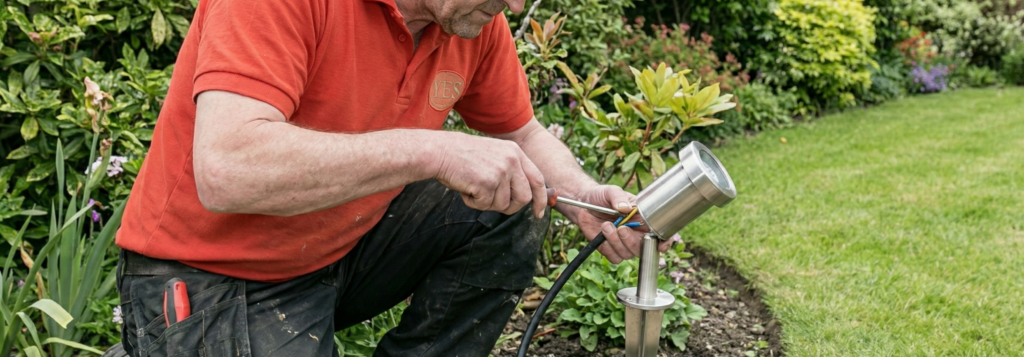
Make the most of your outside space with weatherproof garden, patio and security lighting. Safely wired to the correct IP rating and protected, with switching and sensors to suit.
Why garden lighting transforms your home and garden
Most gardens go dark at 4pm in winter and stay unused until spring. The right outdoor lighting means you can enjoy your garden year-round, extend evenings entertaining friends, keep pathways safe, and make your home look stunning after dark — which increases kerb appeal and even property value. A well-lit garden also deters intruders far more effectively than locks alone, since burglars avoid lit, visible spaces.
Types of garden lighting (and when to use each)
Path & step lighting: Low-level wall or step lights (2–3 watts LED) ensure safe passage after dark without being harsh. Essential if you have a side access, steps, or a driveway. Uplighting: In-ground or spike lights pointing up at plants, trees or house walls create drama and depth — very Instagram-worthy, and makes your garden feel larger. Flood lighting: Brighter general lighting (10–20 watts) for seating areas, patios and decks where you actually spend time. Festoon & string lights: Soft, ambient mood lighting for entertaining — much classier than a bare patio. Security lights: PIR-activated floods or wall lights at entry points (driveway, back door, side gate) that deter intruders by lighting up when motion is detected.
Design principles (so it looks good, not harsh)
Good garden lighting is layered. Start with soft ambient lighting (step lights, uplighting on trees) to set the mood. Add task lighting (flooded patio) where people gather. Use accent lights to highlight your best features (an old tree, a water feature, textured walls). Avoid pointing lights directly at houses or into neighbours' windows — angle downwards or sideways. Warm white (2700K) LED is friendlier than cool white and less likely to attract insects. Most people find 3–5 lights create atmosphere better than one bright flood.
Weatherproof installation and durability
Outdoor lighting must stand years of rain, wind, frost and UV. Every light we install is IP65-rated minimum (fully sealed against water spray). Cabling runs in armoured conduit buried 30cm+ underground (below spade depth), protected at termination points, and connected through an RCD so any fault cuts power instantly. Good quality LED fittings last 15–20 years; cheap outdoor lights corrode or fail within 2–3 years. We specify durable, proven fittings — usually stainless steel or marine-grade plastic — so you don't have to replace them.
Cost and typical setups
Basic path lighting: 3–4 step lights, basic buried cable — £300–500. Medium garden: 6 uplights (trees/planting), 4 path lights, small patio flood — £600–900. Full garden + security: Whole-garden layered lighting plus PIR-activated security lights at entry points — £1,000–1,500. Installation time is 1–2 days depending on cable routing and number of fittings. Most setups are on a single circuit with a timer and/or photocell, so lights come on automatically at dusk and switch off at a set time (usually 11pm).
Timers, sensors and smart control
Photocells automatically turn lights on at dusk, off at dawn — zero manual control needed. Timers let you set lights to come on at 6pm and off at 11pm year-round, reducing wasted energy in summer. PIR motion sensors on security lights mean they only burn when needed. The very best setups combine all three: gentle path lighting always on after dusk, uplighting on a timer (say 6pm–10pm), security floods triggered by motion. Some smart systems let you control everything from your phone — turn off uplighting early if you're not entertaining, or trigger security lights manually if you hear a noise.
Permits and restrictions
Garden lighting in most UK homes needs no planning permission if it's in your garden (not facing a public right-of-way directly). If you're in a conservation area or listed building, check with the council. Light pollution rules mean you shouldn't shine lights upwards into the night sky (bad for birds and insects) — angle everything downwards or sideways. We always advise on placement to meet these requirements.